


The introduction to The Chicago School’s course catalog for its inaugural 1979–’80 academic year cites a report commissioned by the American Psychological Association. The report concluded that “psychology has ‘sufficiently matured’ as a scientific discipline to justify the creation of programs of professional education.” The founders explain, “The Chicago School owes its inception to these developments and to the commitment of practicing psychologists in Illinois to the concept of providing high-quality professional training in a nonprofit setting.” And that dedication to preparing practitioners for the public good continues to expand.
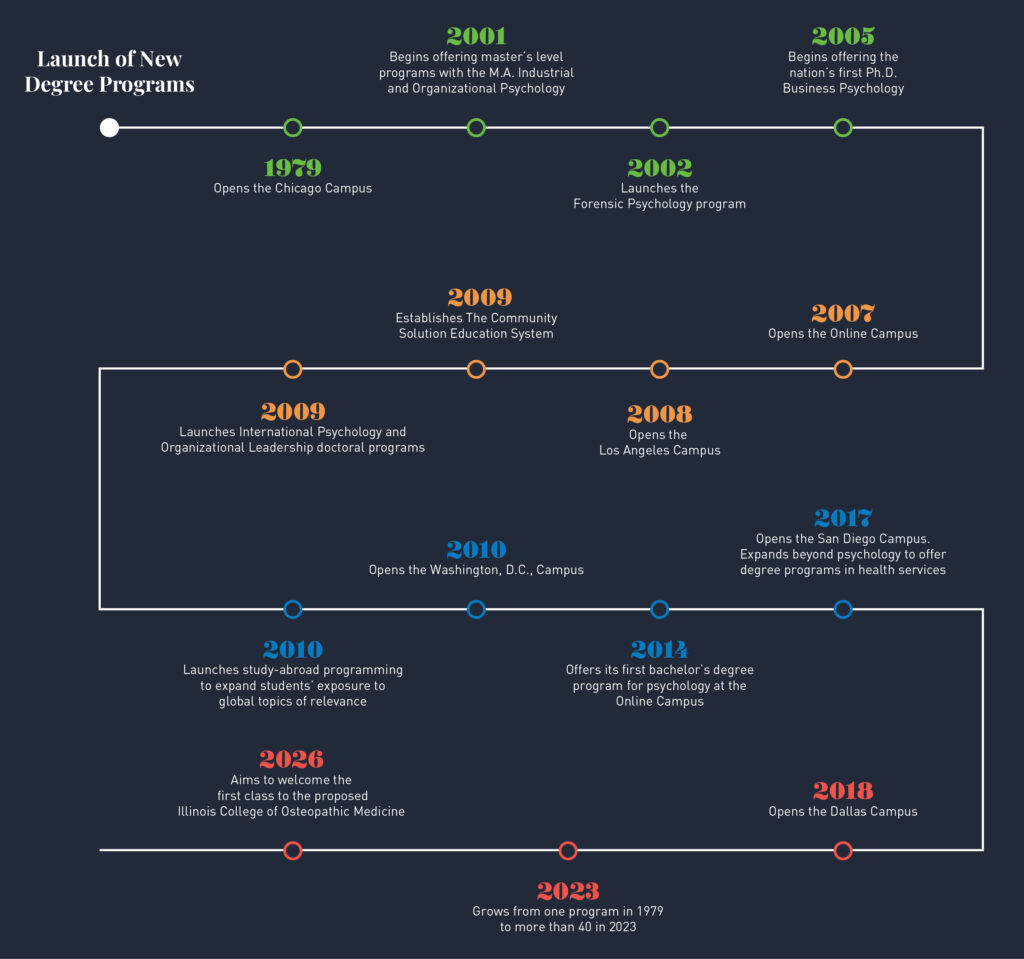
With this mission, the first class of students embarked on the Doctor of Psychology (Psy.D.) program, which prepared graduates to practice in clinical settings (in contrast to research universities where the emphasis typically is on research and teaching) and set the institution on a course toward graduating more than 20,000 practitioners whose impact is felt in a wide range of applications in communities in the U.S. and abroad.
When Michele Nealon, Psy.D., president of The Chicago School, began studying for her doctorate in 1995, she found an institution that was “small in footprint, yet very big in aspirations and intentions.” What inspired her to attend, above all, was the focus on training multiculturally competent practitioners in the field of clinical psychology. “That was something that really resonated with me,” she says. “Even though I was young at the time, I somehow knew that this was an exceptionally important responsibility, as I was pursuing doctoral education.”
While The Chicago School was at the vanguard of the movement to educate Psy.D.s, it had not grasped the potential for new programs to serve communities outside of the mental health area. Michael Horowitz, Ph.D., assumed the presidency in 2000, and created the culture, energy, and framework within the school to expand the programs it offered while maintaining focus on the quality of the faculty. the academics, and the development of well-trained, multiculturally competent psychologists. He committed the institution to offering new programs at new degree levels.
“My commitment was that we learn intentionally what was needed on the ground, to understand the needs in our local community, before implementing a program,” Dr. Horowitz says. “That became a hallmark. We were already committed over many years through the diversity of the workforce we wanted to create in psychology and mental health.”
The Chicago School’s second program offering was Industrial and Organizational Psychology, which has applications across organizations and corporations, from optimizing production efficiency to human resources. The goal for the new program was to attract six students. Fifteen enrolled the first year and 40 the second. A program in Forensic Psychology, which deals with the intersection of psychology and the criminal justice system, was added the next year and attracted 40 students for it first session.
At about the same time, a faculty member suggested that the school needed a program in Applied Behavior Analysis (ABA), which blends research with practice. For Dr. Horowitz, that was a turning point. “The energy has taken hold,” he thought at the time. “The ideas were coming organically from within the institution.”
In its third decade, with the number of Psy.D. students surpassing 100, the institution purchased space within the building at 325 N. Wells St. and the expansion of programs continued.
When surveyed in 2023, more than 93% of respondents from The Chicago School’s class of 2022 reported being currently employed, and more than 84% reported being employed in their field of study. This demonstrates the institution’s commitment to preparing its graduates to make an impact in meeting the growing needs of society from Day 1. “They are in leadership positions, they are in practice positions, they are researchers, they are community advocates, they are authors, and social justice change-makers,” Dr. Nealon says. “What has never once changed is our unwavering commitment to the students, quality academics, and our community impact.”
Creating equitable access and opportunity at a Fortune 100 company
KimLoan Tran, Ph.D.
KimLoan Tran, Ph.D., has come a long way from her native Vietnam to her current role as vice president of talent management for Allstate Corporation, a Fortune 100 company with 55,000 employees worldwide. The daughter of a single mother and the youngest of six children, Dr. Tran immigrated to the U.S. at age 6. Arriving with few possessions and not knowing English, the family struggled to get by in their new country. Dr. Tran’s mother worked two jobs to provide for their basic needs.
A family from church offered to take Dr. Tran in and support her education, which allowed her to attend college on a full scholarship. “My upbringing taught me that talent is evenly distributed, but access to opportunities and resources are not,” she says. “I was the only person in my family to go to college, and that experience reinforced to me the importance of access.” What her family had been through inspired Dr. Tran to pursue a career in psychology based on her desire to study how humans learn and behave in relation to their social environments.
She was attracted to The Chicago School in part because of the practitioner model. “I loved the emphasis on applying real-world application of business and leadership theory,” Dr. Tran says. A second factor in her decision to enroll was the hybrid experience. She was working as a consultant at the time and had to travel a great deal. “It was a perfect support for my busy lifestyle,” she says.
As a leader in the field of human resources, Dr. Tran is tasked with helping guide a large corporation through an era in which concepts such as labor and employment are being reevaluated around the globe. She is currently engaged in a multiyear project aimed at foregrounding capability and skills over job title and tenure with the company. “We’re on a journey to build a new talent and learning operating model to really be able to meet the evolving business needs, because we recognize that hiring alone is not going to solve the talent shortage problem,” she says.
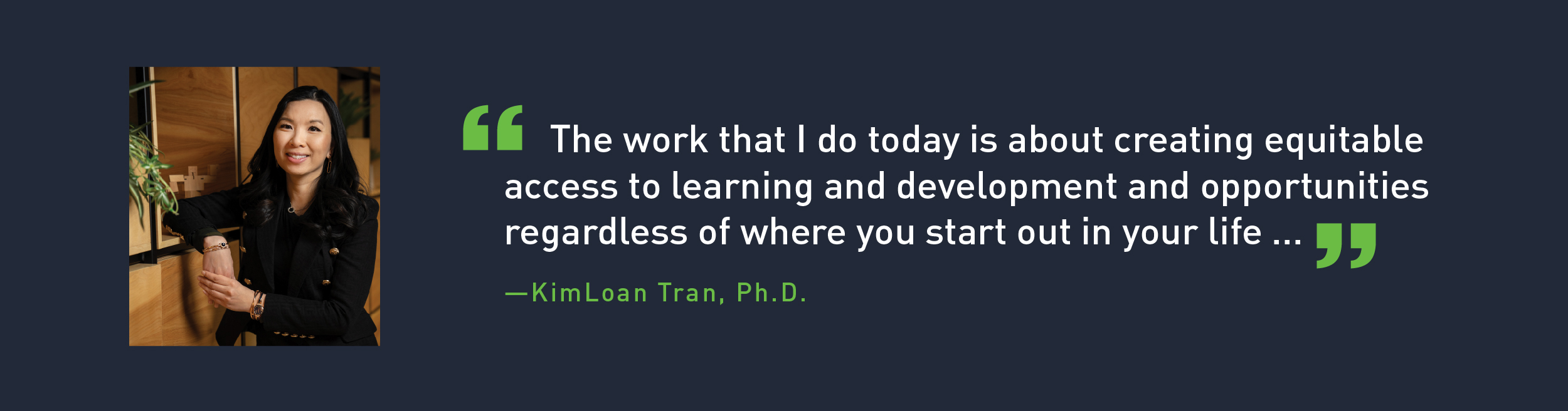
The guidance and support of the family who sponsored her inspired Dr. Tran to make it her life’s mission to offer the same kindness to others. “The work that I do today is about creating equitable access to learning and development and opportunities regardless of where you start out in your life,” Dr. Tran says. “That’s why I love the work that I get to do in talent management. Now I get to do that at scale for organizations, but it’s very personal for me.”
Leading a team treating the incarcerated with respect and compassion
Melvin Hinton, Psy.D.
Melvin Hinton, Psy.D., always knew he wanted to explore the human mind, though he was not sure whether that would lead him to medical school to become a psychiatrist or to pursue an advanced degree in psychology. An on-campus job as an undergraduate helped set his course. He found working for the public safety department at the University of Michigan “fascinating, maybe even life altering,” for how it opened his eyes to the criminal justice system.
As graduation approached, Dr. Hinton’s mentor questioned him about remaining at Michigan for his Ph.D. doing research. However, as he now advises his undergraduate students and interns to do, Dr. Hinton asked himself, “What do I want to do? What do I picture my career like?” The answer was that he wanted to be a practitioner, work with patients, and make a difference in their lives.
For Dr. Hinton, the choice of The Chicago School was a no-brainer after he described his meeting with the faculty as “the most not only interesting but fun and comfortable interview” he had ever experienced.
As a student at The Chicago School, Dr. Hinton was selected through a competitive process to be a diagnostic practicum student at the Cook County Jail. “I started working there in 2001 and have been in corrections ever since, which I am extremely proud of,” he says.
Dr. Hinton concedes that working in corrections is not for everyone. “Walking into a correctional facility is something you have to be prepared for,” he says, “but I loved the work from the very beginning.”
Two aspects of the work motivated Dr. Hinton. First, he realized he could make a difference in that setting. Second, he says, “Unfortunately, the criminal justice system is largely, particularly in this part of the country, made up of individuals who look like me.”
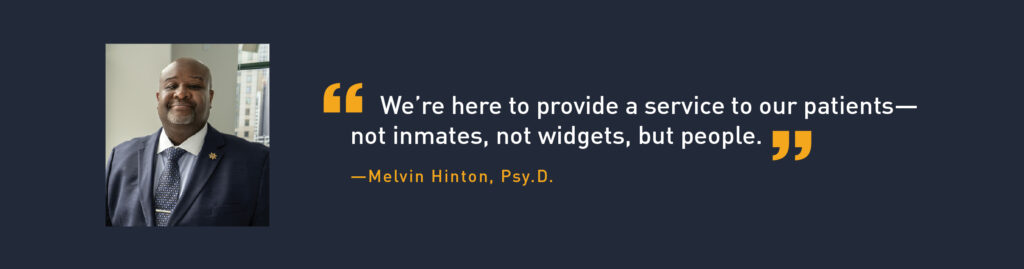
Dr. Hinton has been the chief of Mental Health Services for the Illinois Department of Corrections for 11 years and points with pride at the improvements that have been made within his department, including updating policies and procedures, increasing training and professional development for mental health staff at all levels, and instilling the understanding that, he says, “we’re here to provide a service to our patients—not inmates, not widgets, but people.”
Working with clients to help customers buy and employees buy in
Melina Palmer, M.A.
Melina Palmer, M.A., has always had a curious nature. She was fascinated by why people made choices and believed there must be a science behind decision-making. So, when she read about buying psychology as an undergraduate marketing major, it was as though a light had switched on. “It was about why people do the things they do and buy the things they buy, and I knew it was my calling,” she explains. The field is so new that Palmer spent the better part of a decade calling universities and being told there was no program for her interests.
Once Palmer found behavioral economics, she finally had a path to follow and ultimately chose The Chicago School because of its online option and because it placed a premium on practice over academic research. “Of the few programs that existed at that time, nearly all of them were only about becoming an academic researcher,” she says. “There was almost nothing for people in business who wanted to enhance their skills. That’s why it was so exciting to find a university that actually focused on application.”
During her time at The Chicago School, Palmer discovered that there were almost no resources for people in business looking to apply the amazing insights she was learning about the brain and human behavior. “There was no one translating this for the masses. No one saying things like, ‘This is framing, this is why it matters, and this is how you can use it to increase your sales.’ So I decided to do it myself.”
Palmer launched a podcast, “The Brainy Business,” in 2018. I took off quickly, being discovered by academics, entrepreneurs, and people working in businesses around the world. The show now has over 1.1 million downloads from more than 170 countries. Its success and global interest has led to three books, a thriving consultancy, countless keynotes, corporate trainings, and an opportunity to pay it forward by co-creating and teaching for a Certificate in Applied Behavioral Economics via the Human Behavior Laboratory at Texas A&M University.
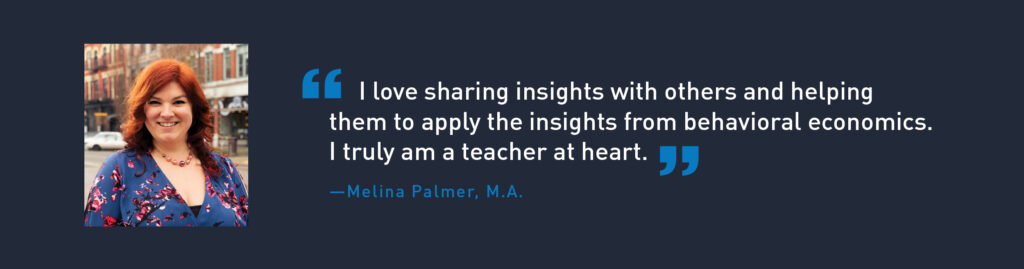
“I love sharing insights with others and helping them to apply the insights from behavioral economics. I truly am a teacher at heart,” says Palmer. “I’m so thankful for The Chicago School and this program. It absolutely changed my life and has allowed me to help so many others.”
Building a culture of safety in the skies and beyond
Tracy Dillinger, Psy.D.
Did you ever think about what goes through an astronaut’s mind in the last seconds before the countdown clock reaches zero? Tracy Dillinger, Psy.D., does. As NASA’s senior executive psychologist, Dr. Dillinger has devoted her career to understanding the role that human factors can play in mishaps in the air and in space and what can be done to prevent them.
“NASA’s a big organization. It’s engineering, technology, and science focused,” she says. “Applying psychology in a way where people understand it and value it and use it is important for the success of our space program.”
Dr. Dillinger has been with NASA for 15 years, first as an active-duty lieutenant colonel in the U.S. Air Force and now as a civil servant who oversees two programs within the Office of Safety and Mission Assurance. The Safety Culture program, which she initiated in 2009, has a mission to ensure everyone in the organization works safely, flags safety concerns, approaches risk with safety as a priority, and trusts the safety mindset. In 2014, Dr. Dillinger developed the Human Factors program, which promotes an understanding of the role of people in preventing mishaps and in understanding why they occur.
In addition to inoculating a culture of safety and an appreciation of the human element, Dr. Dillinger is dedicated to training the space program’s next generation of psychologists. She has developed an internship program to train two Ph.D. candidate interns each year, one focusing on safety culture, the other on human factors.
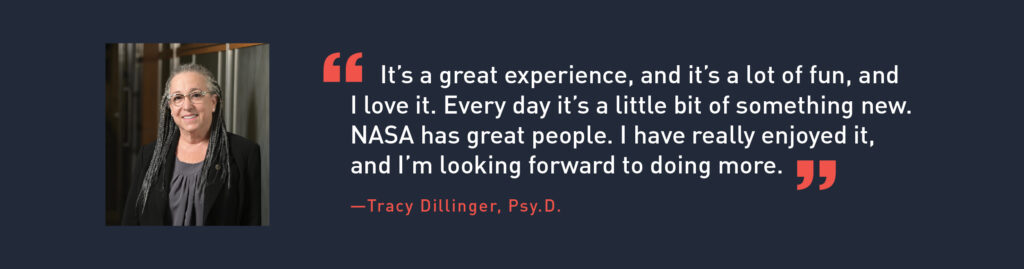
There is no greater challenge than sending astronauts into the great void of space and returning them safely to earth, and Dr. Dillinger remains as committed to the work as ever. “It’s a great experience, and it’s a lot of fun, and I love it,” she says. “Every day it’s a little bit of something new. NASA has great people. I have really enjoyed it, and I’m looking forward to doing more.”
For more information on the program offerings at the Chicago School, fill out the form below.