

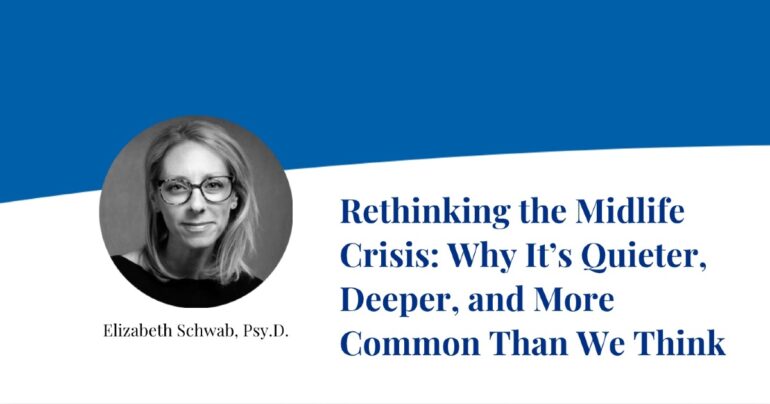
For decades, the idea of a midlife crisis has been associated with visible, dramatic changes. People often made impulsive decisions, extravagant purchases, or experienced sudden shifts to push back against aging. However, Elizabeth Schwab, Psy.D., a behavioral scientist and professor at The Chicago School, argues that this outdated view does not accurately reflect how midlife challenges occur for many today.
Today, this life event is often quieter and more internal. It focuses less on external reinvention and more on personal reflection shaped by changing expectations, health concerns, financial realities, and shifting definitions of success and purpose.
A Shift From External Change to Internal Pressure
Instead of dramatic outward behaviors, many adults experience midlife as a chance to reflect. They often feel disappointment when comparing their current situation to their past expectations. This gap can be unsettling, especially when they feel that time is running out.
Dr. Schwab explains that many individuals sense a growing urgency during midlife. This urgency doesn’t necessarily come from worsened circumstances; it arises because earlier expectations don’t match reality. Careers may not have advanced as planned, personal goals might seem delayed or unreachable, and long-held beliefs about adulthood might begin to unravel.
This pressure often feels self-imposed and is reinforced by societal narratives about achievement and age milestones. People internalize the notion that they should reach certain points by set times, even as these benchmarks no longer reflect contemporary life paths.
Why the “Time Crunch” Feels So Real
Despite longer life expectancy, many adults report feeling more anxious about time as they get older. Dr. Schwab notes that this sense of urgency isn’t caused by aging itself but by how people perceive their health, work, and relationships.
“Age isn’t based in numbers anymore,” she explains. “It’s really based in the internal experience that we’re having: how we feel healthwise, what we’re experiencing at work, and what’s happening at home.”
Health changes often intensify these feelings. Preventive screenings, new diagnoses, and physical changes force people to confront aging more directly than they did in earlier decades.
“These things always existed,” Dr. Schwab says. “We just weren’t really paying attention because we thought, I’ve got so much time.”
Financial Stress and the Cost of Well-Being
Economic pressure also plays a crucial role in midlife distress today. Access to healthcare, healthy food, exercise, and preventive care often relies on financial stability, which feels increasingly unattainable for many families.
As living costs keep rising, people may feel they are falling behind despite working harder than ever. These pressures can heighten feelings of inadequacy or regret, particularly when exposed to extreme wealth through media and social platforms.
Dr. Schwab emphasizes that comparing oneself to highly visible success stories, especially those involving significant wealth, can skew perceptions of what a fulfilling life looks like. For many, these comparisons create unrealistic expectations that deepen dissatisfaction rather than inspire positive changes.
A Uniquely American Experience
Research shows that midlife distress may be particularly pronounced in the United States. Dr. Schwab points out differences in social support, healthcare access, and family networks compared to other countries.
In many parts of the world, affordable healthcare, paid family leave, and stronger social safety nets help ease the burden of aging. In contrast, Americans often face these challenges alone, reinforcing the belief that personal struggles indicate personal failures.
Culturally, Americans tend to treat aging and personal difficulties as private issues. “It’s a uniquely American thing to think that these problems are just ours and ours alone to solve,” she says.
The Importance of Community and Connection
Dr. Schwab believes that one of the most effective ways to prevent midlife from becoming a crisis is through connection. Sharing experiences with friends, family, neighbors, and community members helps normalize what many assume they face alone.
Community creates room for perspective, humor, and mutual support. It serves as a reminder that aging, uncertainty, and changing priorities are universal experiences—not personal shortcomings. Meaningful relationships foster a sense of belonging, which is vital for emotional well-being during midlife.
Reaching out does not require grand gestures. Simple, consistent connections can help people feel grounded and supported as they navigate complex life transitions.
Reframing Midlife as Opportunity
Dr. Schwab encourages individuals to view midlife not as a period of decline but as a chance to rethink purpose and redefine success. Many of the limits felt during midlife are self-imposed and shaped by beliefs about what is “too late” or no longer possible.
Changing these beliefs can be life-changing. Growth, learning, and change don’t have expiration dates, and fulfillment doesn’t follow a single timeline. Midlife can be a time for renewed clarity, an opportunity for individuals to focus on what truly matters, discard unrealistic expectations, and pursue goals that reflect their values.
At its heart, midlife is not about crisis but adjustment. With community, perspective, and self-compassion, it can transform into a meaningful turning point rather than a moment of loss.