

During Women History Month, I published an article about how women are paving the way in integrated health. The article featured small excerpts from interviews with three brilliant women: Adrianne Strachan, M.A., LPC-S; Alisha DeWalt, Ph.D., dean of the College of Graduate and Professional Studies; and Monica Kinde, Ph.D., senior associate dean of Pre-Clinical Affairs for the Illinois College of Osteopathic Medicine. These women have been shaping the future of care in The Chicago School. For this three-part article series, I am sharing the entirety of their contributions.
I asked them each five questions, all specifically tailored to their role in our organization. The result is a trove of experiences and knowledge. You will find poignant and needed advice for future professionals in the fields of mental/behavioral health and medicine, particularly women.
Together, their perspectives offer a powerful glimpse into the future of integrated health and the women leading that transformation. To fully appreciate the depth of their experiences, insights, and advice, I invite you to read the complete interviews and explore how their journeys are shaping more compassionate, inclusive, and effective models of care for the generations to come.
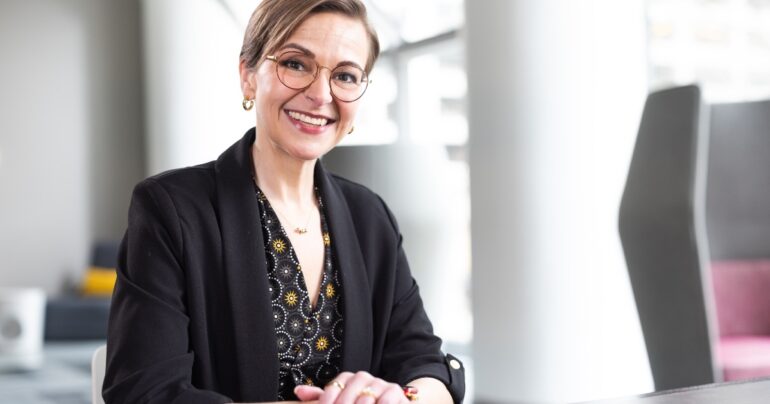
Monica Kinde, Ph.D., senior associate dean of Pre-Clinical Affairs for the Illinois College of Osteopathic Medicine
Dr. Monica Kinde reiterates IllinoisCOM’s commitment to a holistic, integrated approach to medical education, and she reinforces the importance of diversity in advancing health equity while talking about how personal experiences, cultural background, and intersectionality are essential to effective care, as they inform and promote trust and ease communications, particularly in underserved communities.
Reflecting on her own career, Dr. Kinde highlights the value of authenticity, confidence, and integrity in leadership, especially as a woman in a traditionally male-dominated field, and underscores how mentorship, personal challenges, and staying grounded in one’s values shape growth.
Q: Why is integrated health important, and how does IllinoisCOM approach it?
A: At IllinoisCOM, integrated health is the foundation upon which we have built our entire medical school. As we train the next generation of osteopathic physicians, we believe the most urgent thing we can do is prepare them to see the whole person sitting in front of them. Their biology, yes, but also their psychology, their relationships, their culture, their community, and their lived experiences.
This conviction is embedded in every layer of our curriculum design. Rather than siloing physical health from behavioral health, we have designed our program so that mental and physical health education are interwoven from the first week of training. Our keystone Mind and Medicine course series is a direct expression of this commitment and uses a biopsychosocial framework to help students understand that “there is no health without mental health”—that a patient’s anxiety does not exist apart from their hypertension, or their diabetes management is inseparable from their mental health, their food security, and their social support systems.
That said, curriculum alone is not enough if students never practice integrated care. This is why we emphasize radical collaboration in preparing students to work effectively within interprofessional care teams. Through simulated experiences, students can practice complex patient scenarios alongside future psychologists, counselors, social workers, and other behavioral health professionals trained across The Chicago School.
We also prioritize early and sustained clinical exposure. Students are in patient-facing environments from the earliest months of training—again, because integrated care must be practiced rather than just conceptual. The partnerships we are building in Chicago reflect the diverse, complex patient populations our graduates will serve throughout their careers.
The expected outcome of this approach is a physician who sees their patients holistically. We expect our graduates to provide care that is not only medically excellent but genuinely humanizing.
Q: What words would you use to describe the professionals who will graduate from your program?
A: Compassionate. Curious. Collaborative. Culturally humble.
We want our graduates to be known as physicians who wonder not just what is wrong with a patient but what is happening in their life that must be accounted for in order for effective care to occur. I want our graduates to be remembered not only for their competence but for the quality of their presence.
The osteopathic philosophy centers around the interconnectedness of body, mind, and spirit and that the physician’s role is to support the capacity to heal. IllinoisCOM graduates will embody that philosophy as a functional clinical practice. We are training physicians who are scientifically rigorous and deeply human at the same time.
Our graduates will also be resilient and self-aware. We intentionally built into our program opportunities for students to reflect on their own mental health, their stress responses, their progression, and their professional identity. We want graduates who will have long, meaningful careers—physicians who recognize that caring for themselves is inseparable from caring for others.
Q: How important are personal experiences, cultural background, and intersectionality for future medical professionals?
A: Profoundly important, yet we have historically undervalued them.
The evidence is clear: Patients receive better care when they feel understood. Trust builds when a physician shares cultural context with a patient. That trust translates into patients disclosing more, adhering to treatment plans more consistently, and accessing care sooner. In that sense, cultural humility is a critical component of clinical competence. A physician trained to recognize how race, gender, economics, and lived experience intersect in a single exam room is simply a more effective clinician.
This is also why the composition of our student body and faculty matters. Physician diversity has documented improved outcomes for historically marginalized communities. When we recruit and support students from backgrounds historically excluded from medicine, we are directly investing in health equity.
Q: What have your experiences taught you—particularly as a woman in a leadership role in a male-dominated field?
A: I came up in biomedical science and academic medicine. These are fields where women have made extraordinary progress and where structural inequities are still very much present. I have sat in rooms where I was the only woman at the table or where my expertise was questioned before I had spoken a word. Resist the instinct to preface your contributions, to over-qualify your expertise, to make yourself smaller so others are more comfortable. The people who shaped my career most meaningfully were those who taught me that my own perspective and lived experiences were an asset, not a liability.
My path here has not been linear, and I have navigated significant personal challenges along the way. What carried me through was staying anchored in my values and my passion for the people in front of me. A stubborn belief that showing up with integrity for the individuals around you—students, colleagues, communities—is how the world becomes more just and more humane.
I am also a mother of three amazing tiny humans. They have watched me navigate demanding professional work, multiple cross-state relocations, and the exhilarating pressure of launching a new medical school. I hope what they are learning is that ambition and compassion are not opposites. You can lead boldly and love fiercely at the same time.
Q: What advice would you give to young professionals pursuing a career in medicine?
A: My advice to anyone starting their professional journey is to start with your why and hold onto it tightly. The path is long and winding, and the system will surely test it. Your why is not sentimental, it is functional and will carry you through the days that feel impossible.
Seek discomfort early. Those who thrive are willing to sit with ambiguity, to ask the question that reveals a gap in their understanding, to be corrected and grow from it. Build an identity of someone who meets challenges with curiosity rather than fear.
Learn to take care of yourself and ask for help before you think you need to. Professional culture, and particularly that surrounding women in demanding fields, has historically celebrated the erasure of self. Stoicism is mistaken for strength. Struggle is treated as something to hide. This has real costs, professionally and personally. You are not more dedicated because you are depleted. Invest in your mental health, your relationships, your personal life. Ask for help early and often and foster a psychologically safe community where others do the same.