

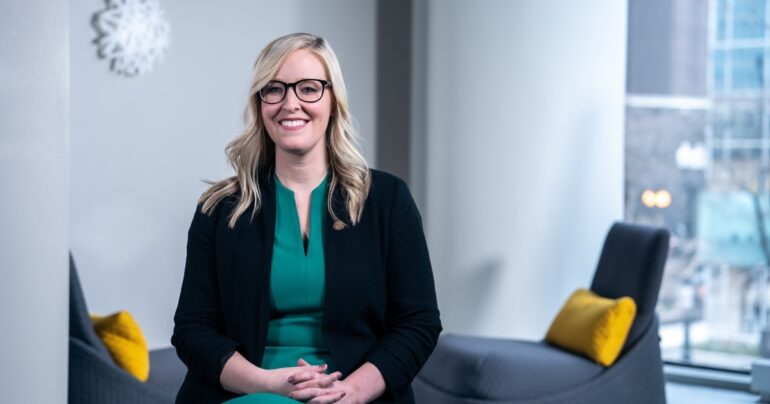
During Women’s History Month, I published an article about how women are paving the way in integrated health. The article featured small excerpts from interviews with three brilliant women: Adrianne Strachan, M.A., LPC-S; Alisha DeWalt, Ph.D., dean of the College of Graduate and Professional Studies; and Monica Kinde, Ph.D., senior associate dean of Pre-Clinical Affairs for the Illinois College of Osteopathic Medicine. These women have been shaping the future of care in The Chicago School. For this three-part article series, I am sharing the entirety of their contributions.
I asked them each five questions, all specifically tailored to their role in our organization. The result is a trove of experiences and knowledge. You will find poignant and needed advice for future professionals in the fields of mental/behavioral health and medicine, particularly women.
Together, their perspectives offer a powerful glimpse into the future of integrated health and the women leading that transformation. To fully appreciate the depth of their experiences, insights, and advice, I invite you to read the complete interviews and explore how their journeys are shaping more compassionate, inclusive, and effective models of care for the generations to come.
Alisha DeWalt, Ph.D., dean of the College of Graduate and Professional Studies
Dr. Alisha DeWalt emphasizes the importance of integrated health as a holistic approach that recognizes mental and physical health as deeply interconnected. Dr. DeWalt uses the terms career-ready, culturally competent, and forward-thinking “changemakers” to categorizes The Chicago School students, particularly those graduating from the College of Graduate and Professional Studies.
She also highlights the critical role of self-awareness, cultural background, and intersectionality in building trust and determining work ethic and style while reflecting on her own nontraditional career path shaped by openness to opportunity, mentorship, and strong professional relationships. As a woman in leadership herself, she underscores values and provide important advice to the next generation of mental and behavioral health professionals.
Q: Why is integrated health important, and what is The Chicago School approach?
A: We say all the time in The Chicago School: There’s no health without mental health. The more we’re able to integrate our work, the better it will be for the person that we’re treating. Physical health and mental needs don’t happen in silo. They don’t happen in a vacuum.
Oftentimes, when you have a physical health need, you also have a mental health need, so it’s important to have an integrated health approach in which you’re looking at the individual as a whole and treating the individual for all of their needs by bringing experts together in a way that begets fantastic outcomes for the individual. Integrated health is meeting the patients where they are.
There’s a shortage of mental health providers in the U.S., and I believe that the integrated health approach is a way to address that gap in a typical clinical setting or hospital.
For example, I have a dear friend who works as part of the care team in a severe spinal cord injury unit. As a counselor working in the hospital setting next to the doctors and social workers, she is addressing the mental health needs of someone who has gone through a very significant spinal cord injury and may need to renavigate their life. They are right there together, ensuring that this person is getting all the care they need. That exemplifies what we’re trying to do, what it means to have integrated care.
Another example of the importance of integrated care is in the primary care setting. Sometimes you go to your primary care physician and fill out a behavioral form. Depending on the results, you may leave the office with a referral, but wouldn’t it be incredible if all physicians were equipped to start these conversations and have someone in the primary care setting ready to take it on but in a more informed way to really create a continuum of care? The Chicago School is working on that front as well, to produce graduates who are ready to move into those types of positions and really modernize what integrated healthcare can look like. We are educating students to be part of the care team, capable of working alongside physicians and many other types of careers, to provide mental and physical care for those who need it.
Q: What words would you use to describe the professionals who graduate from your program?
A: One expression that comes to mind for me is: career ready. We have students who are walking the walk and not only learning in the classroom. At The Chicago School, we ensure students are out training and practicing those skills as soon as possible. That’s evident through our internship programs. The quality of internship opportunities we’re able to secure and the service we provide the community are unparalleled. We really encourage students to give back to the community, and we provide opportunities for them to do so. That drives our students to be career ready. Our students do the work in the classroom, practice during training, so when the time comes for their first job as a Clinical Mental Health Counselor or professional, they are prepared.
I would also say our students are culturally competent. We work to instill cultural competency in our classrooms and ensure we reflect on our own assumptions and biases and how those may come into our clinical work.
Finally, I would say that our students are change-makers. Our curriculum is up to date and forward-looking, tailored to accommodate a new generation of graduate professionals coming into their careers as technology evolves. They will hit the market in a whole different playing field from five to 10 years ago. Our students are trained and ready for their careers.
Q: How important do you think personal experiences, cultural background, and intersectionality are for future mental health professionals?
A: It’s so important. It shows up in so many ways. Everyone comes to the table with their own set of identities and their own influences—from their past, cultural influences—and that shapes how they interact in the world, with clients, etc. Being aware of yourself, your assumptions and biases, understanding how they show up is so important in the work we do. Our experiences influence how we build trust and relationships, how we receive feedback, and how we stay relevant.
Our experiences are who we are; they guide how we show up and how we connect. So, it’s very important that you understand yourself.
Q: What have your experiences taught you during your career? Particularly as a woman currently in a leadership role in higher education (male-dominated), what lessons would you highlight? Looking back, what opportunities brought you here?
A: I started as an undergrad in Applied Behavior Analysis, focused on working with adolescents with autism. I changed my trajectory and came to The Chicago School pursuing a career to become a counselor; I went through my internship, and I liked it. I was good at it, but I didn’t love it. While I was training to be a counselor, I took a student worker position at the university, and I got a glimpse of the behind-the-scenes work it takes for a university to run. I saw myself in that. I was sure I wanted to be involved in psychology—in this helping profession in some way—but decided I would do so in the higher education direction.
It took time, but I saw myself working in this entrepreneurial, managerial world, applying my leadership skills to impact those that could do the frontline work that didn’t fill my cup, that wasn’t my passion. I found my passion in higher education and supporting the next generation of those impacting their communities in such meaningful ways.
I don’t know if there was a moment of realization in my journey, but looking back, I can see that all my experiences led me exactly where I needed to go. The lessons I learned were to be open to opportunities and not overthinking, taking that next step and knowing that you don’t have to be 100% prepared and perfect for that next position that’s waiting for you. You get promoted to grow, and you move up in leadership levels to rise to the occasion. You have to be open to take that next step, open to the opportunity.
I’ve been with The Chicago School for over 13 years, and in many different positions here, I’ve always just been open to taking that next step. Sometimes it wasn’t the right step, and that was okay because I still learned through that process.
I also give credit to the mentors that I’ve surrounded myself with, both strong female and male leaders. I feel that I owe so much to the mentors and those who have continued to bring me forward and help me develop skills both inside and outside the university. Mentorship is incredibly important for those early career days, especially for women.
The last thing I would say is finding your people, for lack of a better term. Find that group that you can rely on and trust to bounce ideas, opportunities, questions, and thoughts with, a group that builds one another up. That supportive group that you can come to. I’m highly relational in my work and life, so, for me, having that group and knowing those people are just 100% supporting each other always has done so much for me, for my work and confidence.
I feel like not a lot of people feel they can say they love their job, that they found their cause and passion.I feel very fortunate to say I do, and I now I mentor others in their path because I know the value of mentorship and what it brings to our lives and careers. I find it so fulfilling to be able to do that for other women today.
Q: What advice would you give to young professionals who are pursuing a career in mental/behavioral health care?
A: Be open to new experiences and trust yourself to find your passion. In this work, you’re going to need passion. There’s also a huge workforce shortage in mental/behavioral health area. So, there’s a need, and there are careers and opportunities in this area that might not be the traditional ones. It might not be a traditional path that you may have known about before because our work continues to evolve.
Much is said about AI. AI will never replace the ability that a professional has to deliver mental health/behavioral care, but we need to look closely at AI as a tool, and how we can embrace it in our work and profession to streamline some of the processes so you can focus more on what matters, the clinical/care work.
We’re also continuing to expand into telehealth. This enables mental health professionals to connect with individuals in rural health areas. This is huge because of the workforce shortage and gap in mental health services in those areas. Being able to bridge that with telehealth has just been fantastic, and that will continue to evolve, so don’t shy away from it; instead, figure out how you can embrace it.
Regarding your own mental health: You will have seasons in your life where you are heavy on the work side, and that is what you need to do, and you’re going to make it work. But you have to be reflective about what your needs are. You really need to think about where you are putting your energy and how you prioritize. You need to reflect on what your boundaries are, knowing that those can shift given what season of life or what your priorities are at the moment. You won’t get everything done. There will always be things hanging, and that’s part of learning. Not everything is going to get wrapped up in a pretty bow at the end of the day. You have to focus on where you’re going to put your energy, where you’re going to have the biggest impact. Be strategic with your day to get the most out of it.