

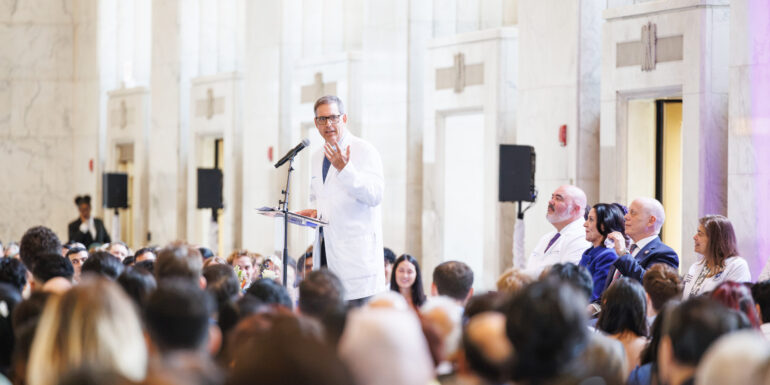
Jonathan Doris, MD, delivered the keynote address at the first white coat ceremony for IllinoisCOM’s inaugural class of 2030. Best known to “Scrubs” fans as “the real J.D.,” the physician whose early career inspired Zach Braff’s character on the show, Dr. Doris is a cardiologist and cardiac electrophysiologist with Southern California Permanente Medical Group in Los Angeles and serves as an associate dean at IllinoisCOM. Beginning in their third year, half of the inaugural class members will complete their clinical training in Los Angeles under his supervision. Following the white coat ceremony, Dr. Doris sat down with INSIGHT to discuss his career and the journey ahead for IllinoisCOM’s first students.
Q: One of the IlinoisCOM students receiving her white coat said she decided to become a doctor because of “Scrubs.” How often do you hear stories like that?
A: Other medical students have approached me over the years and decades with similar stories, that “Scrubs” piqued their initial interest, or that “Scrubs” got them through the difficulties of medical school and residency. In all different stages, it’s a comic look at what you’re going through, but it captures the emotional reality they can really relate to.
Q: How do you now perceive what “Scrubs” captured about being a young doctor?
A: The writers of the show were all brilliant. They really captured the universality of the experience of medical training and medical education, obviously in a comedic way, but the undertone of the show is so relatable to trainees, back when I was training as well as today. They hit the nail on the head capturing that ethos.
Q: Is it true that one of your “red lines” for the show was that you didn’t want it to portray doctors as being in it for the money?
A: There was often negotiation between myself and the writers, and of course [“Scrubs” creator] Bill Lawrence overseeing the whole thing. We tried to balance what is funny from the perspective of comedy writers who had no medical training with the reality of what it is to be a trainee, to practice medicine. There were certain things they may have written about because of their presumption about doctors who want to make money or hospitals that want to just make money versus the reality of someone like me who’s in practice.
Q: What was your career path like beginning in internal medicine?
A: To become a cardiac electrophysiologist, the training path is to become board certified in internal medicine, which is three years, then become board certified in cardiology, which is three years, then do another fellowship in cardiac electrophysiology, which now is two years. It’s an eight-year training post medical school. If you have that goal in mind, you have to become an internist, then a cardiologist, then an electrophysiologist.
Q: Why did you choose electrophysiology as your specialization?
A: When I was in training, electrophysiology was relatively new in terms of the technology and what we were able to do. I came into it at a critical moment, an explosion in our technological abilities to treat rhythm abnormalities, to help prevent sudden cardiac death with devices, to help treat congestive heart failure with cardiac device implants.
Many medical students will end up going into a specialty because they need a mentor, and they want to follow the steps of that mentor. I had mentors in my education and training that led me to that path.
Q: What are your thoughts about being called to service as a doctor?
A: Medicine is a service industry, but I think that what you’re referring to is service in terms of how we best serve a patient who has a diagnosis, who is sick, who needs guidance, who needs treatment. That lies at the very foundation of what it is to be a doctor. I have felt that some of the most meaningful experiences in my career have been true service experiences like, as I mentioned in the speech today, doing medical missions in Vietnam.
Those have been some of the most meaningful experiences in my career. To be able to offer knowledge and procedural expertise, hopefully you can do it as well, charitably. I find that when you do charitable work, you are surrounded by charitable people. It’s a very fulfilling thing that a physician can do no matter what their training background is.
Q: What are your impressions of IllinoisCOM so far?
A: I think today illustrated so clearly the excitement and achievement of taking something from vision to fruition over these four or five years that Dr. Lucas and the whole team has been doing this. This is the culmination of that vision and all that hard work. These students, the energy, the excitement, the feeling of pride, the feeling of accomplishment that they have now that they’re starting medical school, starting medical training, it’s really a great feeling, and I love to see it.
We’re heading into a time when we’re going to have a real shortage of doctors, so it’s encouraging to see these young, dedicated people sacrificing a big chunk of their youth to go through medical training and enter this profession. It really is heartwarming to see, and this was a great day today.