

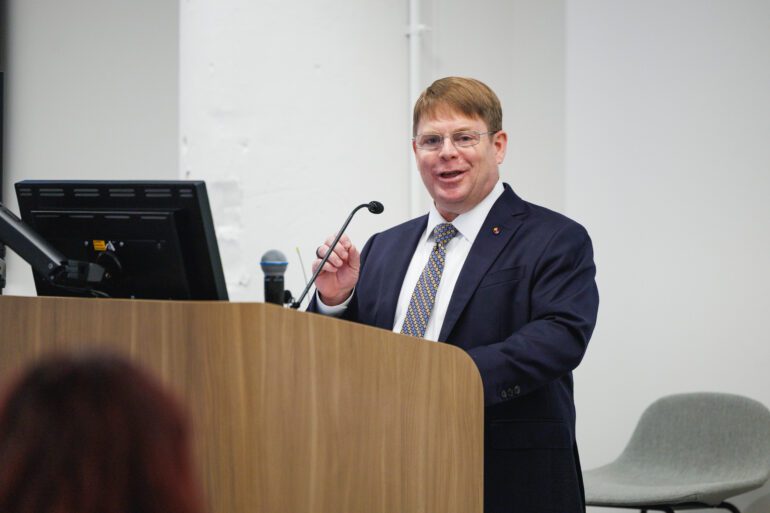
Kevin O’Connor, DO, is a graduate of New York Institute of Technology College of Osteopathic Medicine, a 22-year U.S. Army veteran, and a former White House physician who served two presidents, two vice presidents, and their families. Dr. O’Connor addressed the inaugural IllinoisCOM class during Welcome Week, sharing lessons drawn from his career. Centering his remarks on the advice that shaped his own path—”Express the Interest”—he encouraged the IllinoisCOM students to pursue opportunities rather than wait for them. Following his speech and a wide-ranging Q&A on topics including specialty selection and burnout, Dr. O’Connor spoke with Insight.
Q: Why did you choose osteopathic medicine over allopathic medicine?
A: If I had known then what I know now, I’d say it was whole-person care, the whole mind, body, and spirit, treating a person in the context of their bigger life. But I’d be lying if I said that was the reason, because I didn’t know that back then.
All I knew is I wanted to treat patients. I didn’t know what specialty. I assumed I’d choose either trauma surgery or emergency medicine. It wasn’t until I did rotations that I realized that what I really liked was the word “emergency.” If you’re in an emergency room all day, it’s not like TV; it’s much slower paced.
I realized that, in the military as a family doc, I could still do the trauma stuff, the pre-hospital trauma stuff, and I could still do emergency medicine in the field, but then I could also deliver babies and take care of depression and all these other things.
Q: How did you come to be the first full-time osteopathic doctor serving at the White House?
A: I saw [President George W. Bush] as a consultant several times, and eventually, they invited me to interview to join the team full time. I was selected in 2006. I did two-and-a-half years with President Bush and Vice President Cheney, not as their primary care doctor but as one of the other physicians on the White House medical unit team for nights and trips and weekends. I did two-and-a-half years, and it’s a three-year tour, so I expected to do six more months and then go back to special operations, which is where my heart was.
Because of my seniority, they asked if I would be the physician to the new vice president, Joe Biden. I said, “Sure, I can do anything for six months,” but I fully intended to leave. Then his mom fell and broke her hip. That transitioned naturally to end-of-life planning, which is the bread-and-butter of family medicine. The vice president asked me to stay. I said, “Sure, sir, I’ll finish the term with you.” It was more personal loyalty than anything else.
Then they went and got reelected, which ruined all my plans. It took me 10-and-a-half years to finish my “three-year tour.” I retired from the Army, but he remained my patient. One day, he said, “I think I’m going to run for president.” He asked if I’d come back. How do you say no to a president? In all, I ended up spending 14-and-a-half years at the White House.
Q: What would surprise people about serving in the White House as a physician?
A: I’m not only there doing his primary care; I’m there for the “what if?” We covered the president, the vice president, and the first lady, 24/7/365, anywhere in the world, and it takes a large team to do that. The real purpose of that job is planning. If we’re going to go overseas to two countries and five cities, I’m going to send a three- or four-person advance team to each of those cities, and we know every step he’s going to take.
Our job, along with the Secret Service and the military aid team, is to say, “If something goes bad at this point on the map, where are we going to go? How are we going to get there?” I don’t want to have to decide anything during the chaos; I want to already have a plan to execute. It’s all a matter of constantly thinking about things that will probably not happen, but if they do, you know what you’re going to do.
Q: In your address, you said, “Medicine advances one generation at a time.” What do you foresee for the next generation of osteopathic physicians in America?
A: We have the fastest-growing element in healthcare. What we seem to be doing as a profession is putting most of the satellites out in rural areas, which represents a real opportunity given the need. We’re taking that on, which makes sense because we push primary care a little bit more than some of the more legacy schools.
It’s going to be interesting to see if we can build the graduate medical education along with the schools, because the object is to retain those primary care docs in the communities that we’re building them for. What we don’t want to do is have them all leave those states for other residencies and not come back. It’s going to be a paradoxical, very exciting thing to watch here at IllinoisCOM, because there are a lot of established medical schools in Chicago, but they aren’t pushing a lot of primary care.
Q: What are your impressions of IllinoisCOM?
A: I’m really, really impressed. The facility is unbelievable. What they’re doing in the anatomy lab is a much smarter, more sustainable way to teach anatomy. The tissue looks like it does in the operating room, not like a cadaver. Cadaveric teaching had its place, but this is a much better specimen to learn from.
Every single faculty member I’ve run into is genuinely excited. They’re coming from a diverse background of talent. Each dean I met was another guru from some other slice of excellence. That’s something I would say, knowing Dean Lucas for a long time, that he’s got a knack for doing. He’s always been a person you want to be around, and that tells you about inherent leadership. I’m sure a lot of that is deliberate, but a lot of it is him being somebody people are drawn to. The students will pick up on that quickly.