

They filed in, dressed in bright summer clothes, clustered in groups of two and three, and took their seats at conference tables arranged in two long rows in the high-ceilinged classroom that seats more than 200. The Illinois College of Osteopathic Medicine (IllinoisCOM) class of 2030 represents the first cohort of medical students to begin their studies at a new medical college in Chicago in nearly a century.
Members of the first class of IllinoisCOM range in age from 21 to 41. They come from every corner of the country, from Ivy League schools, Catholic universities, and satellite campuses of large state institutions. Some are recently married; others are new parents. There are immigrants, second-generation children of immigrants, and first-generation college students. Their undergraduate degrees vary from aeronautical engineering to movement science. They share a commitment to academic achievement, a commitment to service, and a pioneering willingness to enroll in the nation’s newest college of osteopathic medicine.
The week’s events were a combination of ceremony, celebration, team building, and learning of the ordinary details of orientation that students everywhere experience in the first week of school, all culminating in the white coat ceremony on Sunday at which the doctors receive their doctors’ coats and are initiated into the medical profession.
Making History From Day One
Founding dean of IllinoisCOM, John Lucas, DO, set the tone for the week when he came to the podium and declared, “Everyone in this room today is making history. Every tradition this school will have as IllinoisCOM, you are creating right now, this week, this year. You’re going to have an incredible impact in ways you can’t even imagine.”
Dr. Lucas offered three points that he wanted the students to remember throughout their medical education and careers: First, that medicine is a service profession; second, that medicine is a “team sport;” and finally, that the students won’t be working alone.
“Look at the people sitting around you right now,” Dr. Lucas said. “Some of them will become your closest friends. Some will be your colleagues. You’re going to share some of the most difficult times of your lives, and you’ll learn to lean on one another.”
In her remarks on day one, President Michele Nealon, Psy.D., noted that the opening of IllinoisCOM represents a next leap forward for The Chicago School. In a keynote address, Omar Lateef, DO, President and CEO of Rush University System for Health and Rush University Medical Center in Chicago, remarked that the key to success for the future physicians is to block out the noise and trust their dreams. In exchange, they get to change the world by being doctors.
It has long been a conviction among the faculty and administrators of The Chicago School that mental health is essential to physical health. “This is exactly why the Illinois College of Osteopathic Medicine exists today,” Dr. Nealon said, explaining that integrated care is not just another model; it is the future of healthcare, and it is the future that the IllinoisCOM faculty will prepare the students for.
Following speeches and lunch, the students returned for an orientation session, a reminder that the next Monday, once the fanfare had subsided, they would be immersed in their studies, with four years of rigor, challenges, and self-discovery ahead.
Following the information session, the students were teamed in small groups and sent on a scavenger hunt, during which they followed clues that took them to the key locations on campus that they would be frequenting throughout their studies.
Lessons in Service and Leadership
The second day’s keynote speaker was George Chiampas, DO, a team doctor for the Chicago Bears and Chicago Blackhawks professional sports teams. Recounting pushback he had received for making tough choices in moments of crisis, Dr. Chiampas urged the students to remember that when they put their patient first, the difficult decisions will take care of themselves.
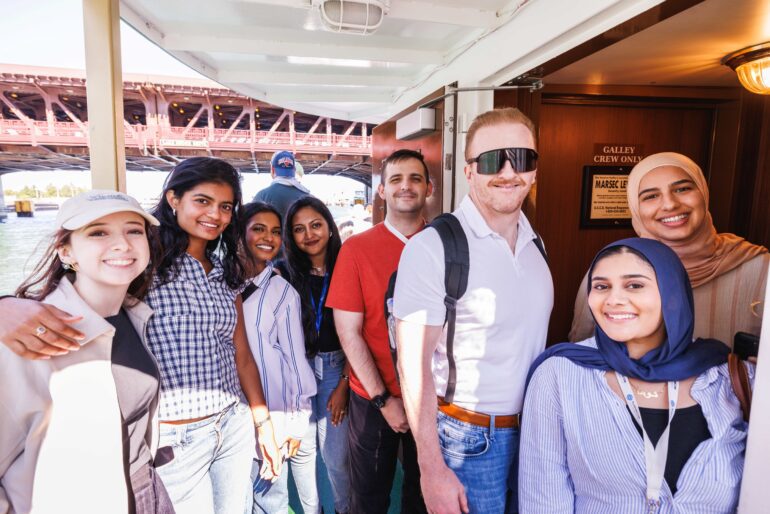
Following the morning’s speeches, the students were introduced to the simulation, anatomy, and osteopathic manipulative medicine (OMM) labs where they will be spending much of their time over the next two years. Afternoons for the rest of the week were given over to team-building exercises, including a boat tour of the Chicago skyline. On Thursday, the students met up at the Greater Chicago Food Depository where they worked with faculty to repackage food and vegetables for distribution.
The third day of orientation began with a keynote address by Kevin O’Connor, DO, who served as the head surgeon with the U.S. Army’s vaunted Delta Force as well as 14 years in the White House serving two presidents, vice presidents, and their families.
“People want to see you succeed,” Dr. O’Connor told the students. “There’s nothing that makes you feel better than being able to directly open a door for somebody.”
From Medical Students to Student Doctors
The events of orientation week culminated in a white coat ceremony, which was held in Chicago’s historic Old Post Office. Under the high vaulted ceilings of the building’s atrium, the leadership of IllinoisCOM sat on stage as the students sat on each side of the rostrum, their friends and family behind, on a day that represented a culmination of their dreams and aspirations as well.
Dr. Lucas, who served as master of ceremonies, described the now traditional white coat ceremony’s origin at Columbia University in the early ’90s. The white coat is a symbol, Dr. Lucas explained, “that creates a psychological, intellectual, and ethical contract in the profession, and it establishes the empathy that is central to the practice of medicine from day one.”
The keynote speaker was Jonathan Doris, MD, Dr. Doris is a cardiologist and cardiac electrophysiologist with Southern California Permanente Medical Group in Los Angeles and serves as an associate dean at IllinoisCOM. He is perhaps best known as the real-life inspiration for the character Jonathan “J.D.” Dorian, played by Zach Braff on the Emmy-Award-winning television series “Scrubs.”
“As you step forward today, you receive your coats, recognize the weight of this moment,” Dr. Doris said. “You aren’t just joining the profession; you’re founding a legacy at IllinoisCOM. You were chosen to be the first class for your aptitude, emotional intelligence, and passion for medicine. Continue with that fortitude and humility. Go learn to be great doctors. Keep your sense of humor and feel confident that you know more than you think you do. Then, tell yourself, ‘If Real J.D. could do this, I can too.’”
Monica Kinde, Ph.D., senior associate dean of Pre-Clinical Affairs at IllinoisCOM, described the challenge coin each student would receive along with their white coats. The coin features an image of the Chicago skyline on one side and the IllinoisCOM building on the other and are symbols of unity, pride, and shared purpose among those who carry them.
Once the students had all donned their white coats, Teresa Hubka, DO, past president of the American Osteopathic Association, had the students raise their hands to recite the Osteopathic Code. Once their hands came down, the students, now student doctors, rose as the applause of proud (and likely relieved) parents, siblings, extended family, and well-wishers echoed through the marbled room, knowing that the work toward their career as physicians begins in the morning.